
Pickup currently unavailable
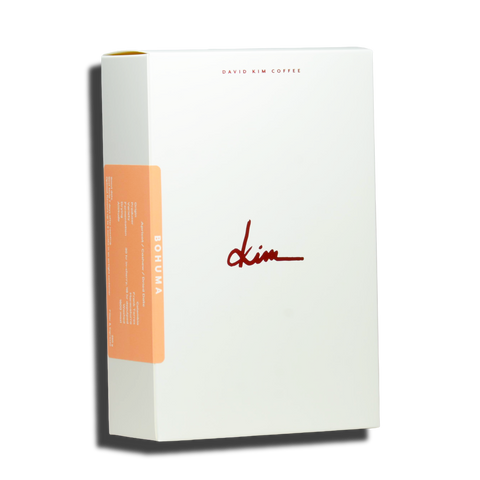
BOHUMA – stone fruit notes with a lower acidity and higher sweetness
- Variety: Gesha
- Altitude: 1500 mamsl
- Region: West valley, Costa Rica
- Producer: Alejo Castro
- Farm: Volcan Azul
- Process: Red Honey
- Notes: Persimmon, roasted walnut, caramel
Volcan Azul
Volcan Azul, owned by Alejo Castro, is a distinguishedcoffee farm located in the highlands of Costa Rica.Alejo, whose family has a long tradition in coffeecultivation, has dedicated himself to elevating the farm'squality and environmental responsibility. Under hismanagement, Volcan Azul has become renowned for itsmeticulous approach to coffee production, includingadvanced drying and processing methods, as well as thecultivation of unique coffee varieties.
The history of Volcan Azul and Alejo’s family is deeply intertwined with the development of Costa Rica’s coffee industry. The family’s journey began in the early 19th century with Alejo Castro Jiménez in Costa Rica and Wilhelm Kahle in the south of Mexico after acquiring land in the fertile highlands of Costa Rica. Today this place is referred to as Hacienda Colima, a farm still owned and operated by Alejo.
Alejo has continued the family tradition of excellence incoffee cultivation by modernizing practices whilehonoring the rich heritage of his ancestors. Through theuse of advanced techniques such as meticulous soilmanagement and innovative processing methods, thefarm has set a benchmark in the industry.
Gesha Variety
The gesha coffee variety, was first introduced to thecoffee institute of Costa Rica in 1950. At Volcan Azul,the seeds were purchased at the institute and somedirectly from Panama. The trees now thrive at a baseelevation of 1,650m above sea level for this particular lotand can go up to 1800m. Alejo first planted the variety in2012 and had to wait 4 years in order to obtain the firstharvest. In 2017, Volcan Azul was awarded thepresidential award at the cup of excellence for theirgesha lot. Since then, they have competed at other cupsof excellence, winning a total of 5 international awards.Alejo’s careful cultivation and commitment tomaintaining the gesha’s heritage contribute to thefarm’s reputation for producing some of the finest geshavarieties in the specialty market.
Processing Details
After measuring the Brix content, the cherries are harvested. Floaters are separated, and the cherries are depulped without washing off the mucilage. The coffee is then placed on the drying patio and left to rest for one day, allowing the mucilage to adhere to the bean. From 8a.m. to 2 p.m., the coffee is stirred, and afterward, it is covered with plastic to maintain temperature overnight.This process continues for about 11 days until the beans reach a moisture content of 10.5–11%. The coffee then rests for 1.5–2 months before preparation for export, which involves hulling and sorting by size, density, and coloUr.
Coffee can be dried using various methods, including patio drying, parabolic raised beds, and mechanical dryers, each significantly affecting the coffee's structure, density, and shelf life. At Volcan Azul, different drying techniques are employed based on the lot size: patio drying and mechanical dryers are used for larger batches, while raised beds are reserved for micro-lots.Patio drying, conducted at 1,500 meters above sea level, benefits from cooler temperatures that slow the drying process and enhance the beans' aromatic development. In 2021, Volcan Azul invested in expanding its drying infrastructure, doubling the size of the drying patio and adding two new mechanical dryers.